Home
1
News
2
News
3
* Aware of it but no action on it4
http://www.hsvg.org/ Guahan Global Foundation
Guahan Global Foundation P.O. Box 206, Hagatna, GU 96932, USA
(October 16, 2026) Aware of it but no action on it To promote breast cancer awareness, prevention, and research in October, the American Cancer Society recently released the findings of its new survey, pointing out that significant gaps exist between awareness of modifiable breast cancer risk factors and taking positive action to lower risk.   After decades of campaigning breast cancer awareness in October, it is exciting that the survey found 99% of 32,775 survey respondents know that smoking raises cancer risk. 91% of them learn low physical activity levels raise risk. 89% of women know excess body weight increases risk. 85% of ladies know alcohol use is also going to raise risk.   The survey also looked into awareness of breast cancer risk and protective factors by race and ethnicity. Among Asian Americans, Native Hawaiians, and Pacific Islanders (AANHPI), 99% of women in this group know that smoking raises cancer risk. 92% of them learn low physical activity levels raise risk. 89% of them know excess body weight increases risk. The percentage of AANHPI women knowing alcohol use could raise risk is also 89%.   It is great to learn that the awareness levels of breast cancer risk factors among AANHPI ladies are as high as overall survey respondents.   However, while 91% of women surveyed know that low levels of physical activity increase cancer risk, only 27% of the same respondents meet the American Cancer Society’s recommendation of 150 to 300 minutes of moderate-intensity activity, or 75 to 150 minutes of vigorous-intensity activity, each week.   Alcohol use shows the second-widest gap in the survey, with 85% of women knowing alcohol raises cancer risk and 69% still report drinking to some extent.   In addition, 89% of women know excess body weight increases cancer risk, but only 47% meet the American Cancer Society’s recommendation of staying at a healthy body weight throughout your life. And, 99% of ladies know smoking raises risk, but 28% of them do not avoid smoking or quit.   The research of the survey did not further investigate the awareness-action gaps of each ethnicity group. Given that Guam’s adult obesity prevalence was getting higher in recent years, it is reasonable to infer that quite a number of people in our island community did not take action to really balance their food intake and physical activity even though the awareness of risk factors may be high.   When the U.S. Centers for Disease Control and Prevention (CDC) released 2023 Adult Obesity Prevalence Maps for 48 states, the District of Columbia, and 3 territories in September 2024, Guam’s adult obesity rate was above 35% for the first time. On the CDC’s 2024 maps released in December 2025, Guam’s adult obesity rate increased again and was surprisingly jumping to 40.2%. There were only 3 states or territories with 40% or higher adult obesity rates.   However, in addition to diet and exercise, body weight is affected by many other factors, including genetics, hormones, environment, medications, and stress. An individual’s willpower alone does not drive weight-loss outcomes. A supportive ecosystem is crucial and necessary.   So, our foundation wants to point out that the American Cancer Society actually emphasized their survey results highlight the importance of initiatives to expand access to “safe, walkable community” and “affordable, healthy food” to help people easily take action in their daily life to increase physical activity and eat healthy.   Regarding “safe, walkable community,” it means people are able to safely and comfortably walk around their neighborhood, instead of driving to certain places and then walking or running there. Obviously, the system on our island has to allocate lots of resources to improve certain infrastructure to reach this goal. In addition, at the same time, the issues of stray dogs must be addressed. Otherwise, many people will not feel safe walking around their village.   Our island community also needs to work harder to secure the stability of the shipment of fresh food from off-island as well as the supply of the locally produced food, helping people's access to “affordable, healthy food.” That is why our foundation appreciates the hard work of the Port Authority of Guam, the shipping companies, and all related parties. We also admire the continuous efforts made by many local farmers, experts, and organizations that try to strengthen our island’s food resiliency.   The American Cancer Society also mentioned in its report that the findings of the survey have implications for public health awareness efforts as well as conversations between healthcare providers and their patients.   For example, breastfeeding for women who have children and can breastfeed is the least-known protective factor in the survey. Only 55% of women know that breastfeeding for several months after childbirth may offer the added benefit of reducing breast cancer risk. Its awareness level is much lower than other factors’. The percentage of AANHPI women knowing this protective factor is also just 57%. Some improvement could be made through public health awareness efforts or conversations between healthcare providers and their patients.   It is also important that people pursuing a healthy body weight can learn the science behind weight management from professionals. Our foundation looks forward to more relevant conversations between healthcare providers and their patients to facilitate the learning and motivate patients to take action on obesity or other health issues.   Finally, we would like to stress once again that steady lifestyle changes are helping long-term well-being. Once you make a start, even small improvements can bring meaningful benefits. So, regarding prevention, please do take action to make some changes after you are aware of the risk factors. Let’s close the awareness-action gaps. (This op-ed article is Guahan Global Foundation's column published in the Guam Daily Post on October 16, 2026) http://www.hsvg.org/hot_540987.html * Aware of it but no action on it 2026-10-16 2027-10-16
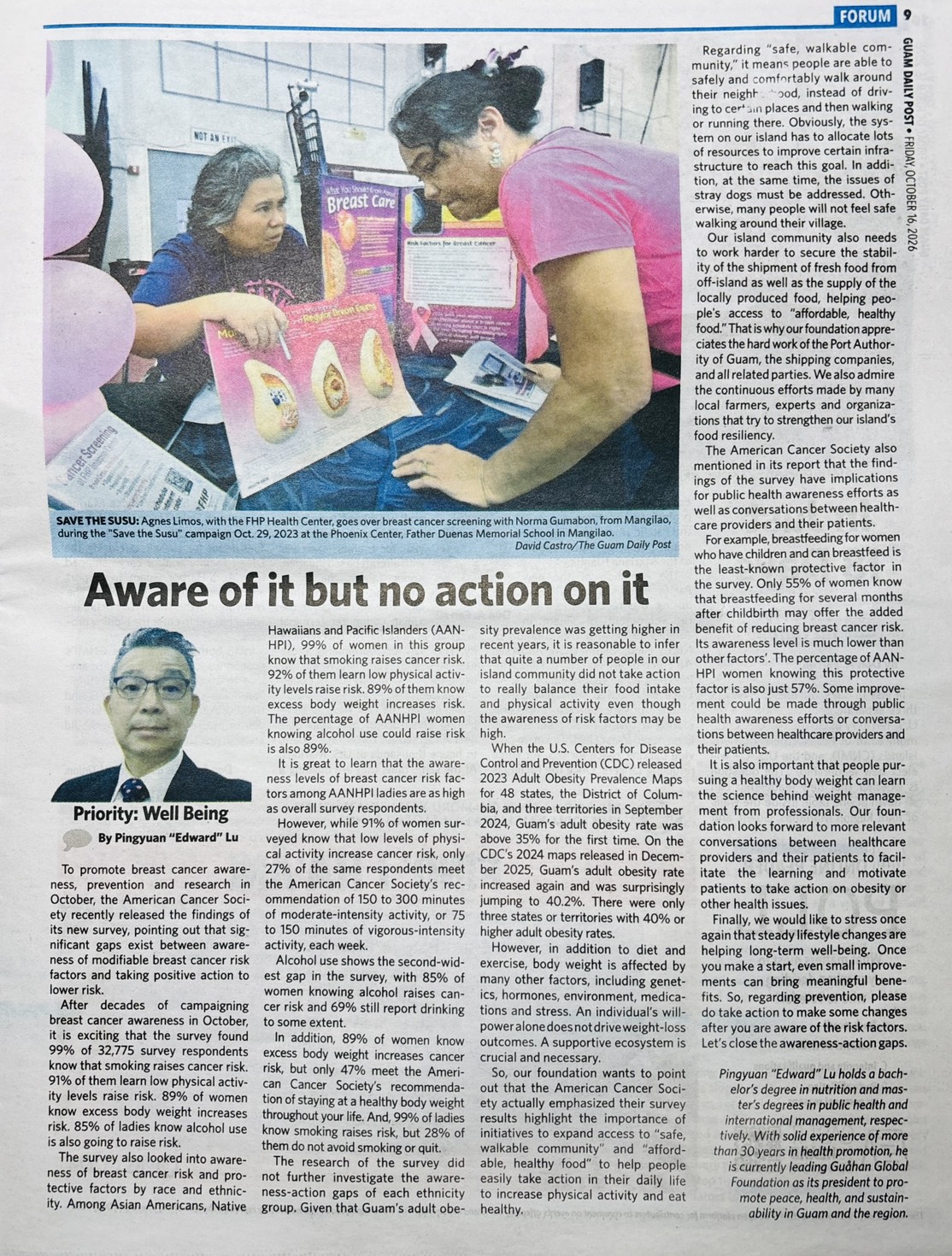

Guahan Global Foundation P.O. Box 206, Hagatna, GU 96932, USA http://www.hsvg.org/hot_540987.html
https://schema.org/EventMovedOnline https://schema.org/OfflineEventAttendanceMode
2026-10-16 http://schema.org/InStock TWD 0 http://www.hsvg.org/hot_540987.html

(October 16, 2026)

Aware of it but no action on it


To promote breast cancer awareness, prevention, and research in October, the American Cancer Society recently released the findings of its new survey, pointing out that significant gaps exist between awareness of modifiable breast cancer risk factors and taking positive action to lower risk.


After decades of campaigning breast cancer awareness in October, it is exciting that the survey found 99% of 32,775 survey respondents know that smoking raises cancer risk. 91% of them learn low physical activity levels raise risk. 89% of women know excess body weight increases risk. 85% of ladies know alcohol use is also going to raise risk.


The survey also looked into awareness of breast cancer risk and protective factors by race and ethnicity. Among Asian Americans, Native Hawaiians, and Pacific Islanders (AANHPI), 99% of women in this group know that smoking raises cancer risk. 92% of them learn low physical activity levels raise risk. 89% of them know excess body weight increases risk. The percentage of AANHPI women knowing alcohol use could raise risk is also 89%.


It is great to learn that the awareness levels of breast cancer risk factors among AANHPI ladies are as high as overall survey respondents.


However, while 91% of women surveyed know that low levels of physical activity increase cancer risk, only 27% of the same respondents meet the American Cancer Society’s recommendation of 150 to 300 minutes of moderate-intensity activity, or 75 to 150 minutes of vigorous-intensity activity, each week.


Alcohol use shows the second-widest gap in the survey, with 85% of women knowing alcohol raises cancer risk and 69% still report drinking to some extent.


In addition, 89% of women know excess body weight increases cancer risk, but only 47% meet the American Cancer Society’s recommendation of staying at a healthy body weight throughout your life. And, 99% of ladies know smoking raises risk, but 28% of them do not avoid smoking or quit.


The research of the survey did not further investigate the awareness-action gaps of each ethnicity group. Given that Guam’s adult obesity prevalence was getting higher in recent years, it is reasonable to infer that quite a number of people in our island community did not take action to really balance their food intake and physical activity even though the awareness of risk factors may be high.


When the U.S. Centers for Disease Control and Prevention (CDC) released 2023 Adult Obesity Prevalence Maps for 48 states, the District of Columbia, and 3 territories in September 2024, Guam’s adult obesity rate was above 35% for the first time. On the CDC’s 2024 maps released in December 2025, Guam’s adult obesity rate increased again and was surprisingly jumping to 40.2%. There were only 3 states or territories with 40% or higher adult obesity rates.


However, in addition to diet and exercise, body weight is affected by many other factors, including genetics, hormones, environment, medications, and stress. An individual’s willpower alone does not drive weight-loss outcomes. A supportive ecosystem is crucial and necessary.


So, our foundation wants to point out that the American Cancer Society actually emphasized their survey results highlight the importance of initiatives to expand access to “safe, walkable community” and “affordable, healthy food” to help people easily take action in their daily life to increase physical activity and eat healthy.


Regarding “safe, walkable community,” it means people are able to safely and comfortably walk around their neighborhood, instead of driving to certain places and then walking or running there. Obviously, the system on our island has to allocate lots of resources to improve certain infrastructure to reach this goal. In addition, at the same time, the issues of stray dogs must be addressed. Otherwise, many people will not feel safe walking around their village.


Our island community also needs to work harder to secure the stability of the shipment of fresh food from off-island as well as the supply of the locally produced food, helping people's access to “affordable, healthy food.” That is why our foundation appreciates the hard work of the Port Authority of Guam, the shipping companies, and all related parties. We also admire the continuous efforts made by many local farmers, experts, and organizations that try to strengthen our island’s food resiliency.


The American Cancer Society also mentioned in its report that the findings of the survey have implications for public health awareness efforts as well as conversations between healthcare providers and their patients.


For example, breastfeeding for women who have children and can breastfeed is the least-known protective factor in the survey. Only 55% of women know that breastfeeding for several months after childbirth may offer the added benefit of reducing breast cancer risk. Its awareness level is much lower than other factors’. The percentage of AANHPI women knowing this protective factor is also just 57%. Some improvement could be made through public health awareness efforts or conversations between healthcare providers and their patients.


It is also important that people pursuing a healthy body weight can learn the science behind weight management from professionals. Our foundation looks forward to more relevant conversations between healthcare providers and their patients to facilitate the learning and motivate patients to take action on obesity or other health issues.


Finally, we would like to stress once again that steady lifestyle changes are helping long-term well-being. Once you make a start, even small improvements can bring meaningful benefits. So, regarding prevention, please do take action to make some changes after you are aware of the risk factors. Let’s close the awareness-action gaps.


(This op-ed article is Guahan Global Foundation's column published in the Guam Daily Post on October 16, 2026)