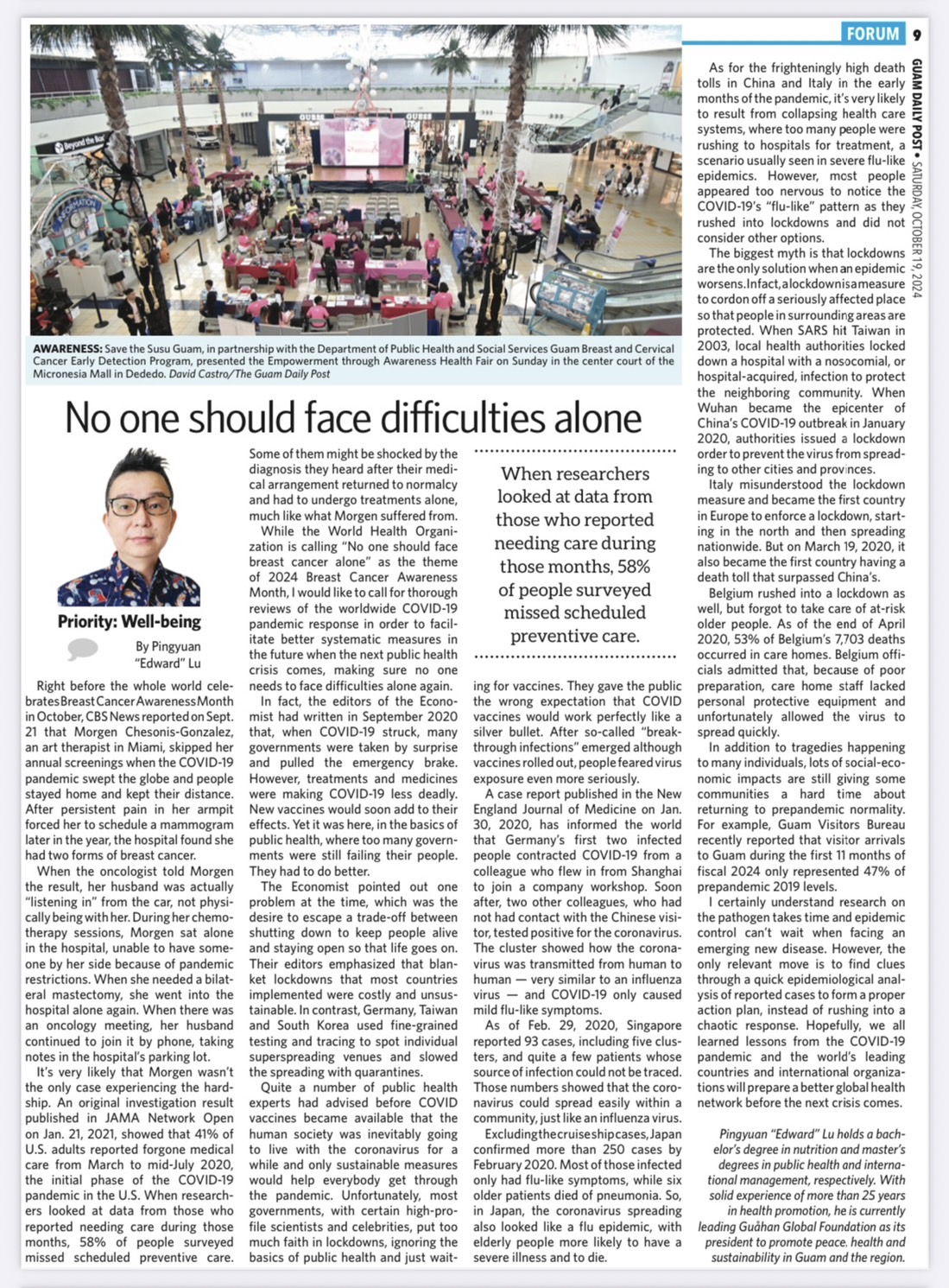
Links:https://www.postguam.com/forum/featured_columnists/no-one-sh ...
A thorough review of the worldwide COVID-19 pandemic response is needed
When Mr. Edward Lu, our Director of Public Health Office and the President of Guahan Global Foundation, was preparing his monthly column in the Guam Daily Post and thinking of the Breast Cancer Awareness Month, he found a CBS News report telling Morgen Chesonis-Gonzalez’s story. She, an art therapist in Miami, skipped her annual screenings when the COVID-19 pandemic swept the globe and people stayed home and kept their distance. After persistent pain in her armpit forced her to schedule a mammogram later in the year, the hospital found she had two forms of breast cancer.
When the oncologist told Morgen the result, her husband was actually “listening in” from the car, not physically being with her. During her chemotherapy sessions, Morgen sat alone in the hospital, unable to have someone by her side because of pandemic restrictions. When she needed a bilateral mastectomy, she went into the hospital alone again. When there was an oncology meeting, her husband continued to join it by phone, taking notes in the hospital’s parking lot.
It’s very likely that Morgen wasn’t the only case experiencing the hardship. An original investigation result published in JAMA Network Open on January 21, 2021, showed that 41% of US adults reported forgone medical care from March to mid-July 2020, the initial phase of the COVID-19 pandemic in the US. When researchers looked at data from those who reported needing care during those months, 58% of people surveyed missed scheduled preventative care. Some of them might be shocked by the diagnosis they heard after their medical arrangement returned to normalcy and had to undergo treatments alone, much like what Morgen suffered from.
While the World Health Organization is calling “No one should face breast cancer alone” as the theme of 2024 Breast Cancer Awareness Month, we would like to call for thorough reviews of the worldwide COVID-19 pandemic response in order to facilitate better systematic measures in the future when the next public health crisis comes, making sure no one needs to face difficulties alone again.
In fact, the editors of The Economist had written in September 2020 that, when COVID-19 struck, many governments were taken by surprise and pulled the emergency brake. However, treatments and medicines were making COVID-19 less deadly. New vaccines would soon add to their effects. Yet it was here, in the basics of public health, where too many governments were still failing their people. They had to do better.
The Economist pointed out one problem at the time, which was the desire to escape a trade-off between shutting down to keep people alive and staying open so that life goes on. Their editors emphasized that blanket lockdowns that most countries implemented were costly and unsustainable. In contrast, Germany, Taiwan and South Korea used fine-grained testing and tracing to spot individual super-spreading venues and slowed the spreading with quarantines.
Quite a number of public health experts had advised before COVID vaccines became available that the human society was inevitably going to live with the coronavirus for a while and only sustainable measures would help everybody get through the pandemic. Unfortunately, most governments, with certain high-profile scientists and celebrities, put too much faith in lockdowns, ignoring the basics of public health and just waiting for vaccines. They gave the public the wrong expectation that COVID vaccines would work perfectly like a silver bullet. After so-called “breakthrough infections” emerged although vaccines rolled out, people feared virus exposure even more seriously.
A case report published in the New England Journal of Medicine on January 30, 2020 has informed the world that Germany’s first two infected people contracted COVID-19 from a colleague who flew in from Shanghai to join a company workshop. Soon after, two other colleagues, who had not had contact with the Chinese visitor, tested positive for the coronavirus. The cluster showed how the coronavirus was transmitted from human to human — very similar to an influenza virus — and COVID-19 only caused mild flu-like symptoms.
As of February 29, 2020 Singapore reported 93 cases, including five clusters, and quite a few patients whose source of infection could not be traced. Those numbers showed that the coronavirus could spread easily within a community, just like an influenza virus.
Excluding the cruise ship cases, Japan confirmed more than 250 cases by February 2020. Most of those infected only had flu-like symptoms, while six older patients died of pneumonia. So, in Japan, the coronavirus spreading also looked like a flu epidemic, with elderly people more likely to have a severe illness and to die.
As for the frighteningly high death tolls in China and Italy in the early months of the pandemic, it’s very likely to result from collapsing healthcare systems, where too many people were rushing to hospitals for treatment, a scenario usually seen in severe flu-like epidemics. However, most people appeared too nervous to notice the COVID-19’s “flu-like” pattern as they rushed into lockdowns and did not consider other options.
The biggest myth is that lockdowns are the only solution when an epidemic worsens. In fact, a lockdown is a measure to cordon off a seriously affected place so that people in surrounding areas are protected. When SARS hit Taiwan in 2003, local health authorities locked down a hospital with a nosocomial, or hospital-acquired, infection to protect the neighboring community. When Wuhan became the epicenter of China’s COVID-19 outbreak in January 2020, authorities issued a lockdown order to prevent the virus from spreading to other cities and provinces.
Italy misunderstood the lockdown measure and became the first country in Europe to enforce a lockdown, starting in the north and then spreading nationwide. But on March 19, 2020 it also became the first country having a death toll that surpassed China’s.
Belgium rushed into a lockdown as well, and forgot to take care of at-risk older people. As of the end of April 2020, 53% of Belgium’s 7,703 deaths occurred in care homes. Belgium officials admitted that, because of poor preparation, care home staff lacked personal protective equipment and, unfortunately, allowed the virus to spread quickly.
In addition to tragedies happening to many individuals, lots of social-economic impacts are still giving some communities a hard time about returning to pre-pandemic normality. For example, Guam Visitors Bureau recently reported that visitor arrivals to Guam during the first 11 months of fiscal 2024 only represented 47% of pre-pandemic 2019 levels.
We certainly understand research on the pathogen takes time and epidemic control can’t wait when facing an emerging new disease. However, the only pragmatic move is to find clues through a quick epidemiological analysis of reported cases to form a proper action plan, instead of rushing into a chaotic response. Hopefully, we all learned lessons from COVID-19 pandemic and the world’s leading countries and international organizations will prepare a better global health network before the next crisis comes.
Mr. Lu's column titled "One one should face difficulites alone" has been published in the Guam Daily Post on October 19, 2024.